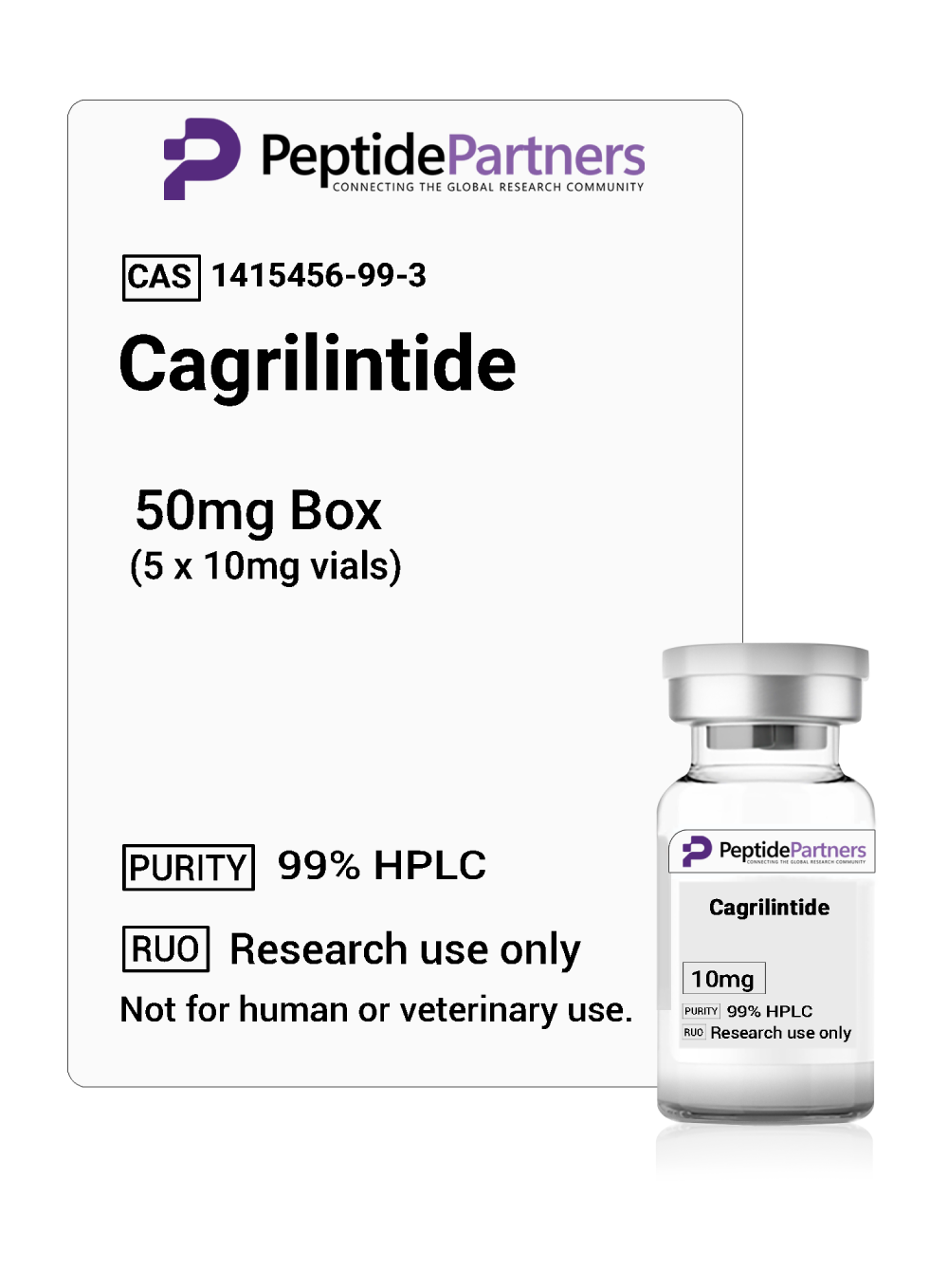


Cagrilintide (10mg vials)
Price range: $335.00 through $1,050.00
-
Research peptide: Cagrilintide, a long-acting amylin-analogue research peptide.
-
Primary research targets: Amylin receptor subtypes AMY1R, AMY2R, and AMY3R, plus the calcitonin receptor (CTR).
-
Format: 10 mg vials with 3 mL vial capacity.
-
Available box combinations: 50 mg, 100 mg, 150 mg, and 200 mg.
-
Testing information: Two Peptide Partners manufacturer records supplied: VI32, batch CAG202603; and WF03, batch CG202607.
-
Research focus: Receptor binding, cryo-EM structural biology, cAMP signaling, receptor dynamics, peptide design, and preclinical metabolic research.
-
Note: A purity percentage and screening results were not provided in the supplied product data.
- Independent certificate details, manufacturer IDs, and batch IDs should be reviewed before purchase when available.
- Order cancellations for full refunds are available before shipment; shipped orders cannot be cancelled or refunded.
- For damaged or incorrect goods, photograph the outer packaging, inner packaging, and product labels, then email support within 48 hours of carrier delivery.
Buy Cagrilintide – Peptide Partners
Product Overview & Specifications
Cagrilintide is a long-acting amylin-analogue research peptide supplied by Peptide Partners for in-vitro testing, laboratory experimentation, structural biology, receptor pharmacology, and metabolic or preclinical research.
Laboratory studies have examined cagrilintide interactions with amylin receptor subtypes AMY1R, AMY2R, and AMY3R, as well as the calcitonin receptor (CTR). Research areas include receptor binding, cryogenic electron microscopy (cryo-EM), receptor-complex conformational dynamics, cAMP and reporter-assay activity, peptide lipidation, and structure–activity relationships.
The supplied product data does not include a purity percentage, endotoxin result, heavy-metals result, purity-screening result, molecular formula, CAS number, or certificate-of-analysis details. Researchers should verify the applicable batch documentation before beginning any experiment.
Product Specifications
| Specification | Details |
|---|---|
| Product name | Cagrilintide |
| Compound type | Long-acting amylin-analogue research peptide |
| Primary research targets | AMY1R, AMY2R, AMY3R, and calcitonin receptor (CTR) |
| Product format | 10 mg vials |
| Vial size | 10 mg |
| Vial capacity | 3 mL |
| Available box combinations | 50 mg, 100 mg, 150 mg, and 200 mg |
| Cost per milligram | $5.25–$6.70 |
| Purity | Not provided in supplied product data |
| Endotoxin screening | Not provided in supplied product data |
| Heavy-metals screening | Not provided in supplied product data |
| Purity screening | Not provided in supplied product data |
| Manufacturer ID | VI32 |
| Batch ID | CAG202603 |
| Additional manufacturer ID | WF03 |
| Additional batch ID | CG202607 |
Primary Research Studies & Findings
Structural and Dynamic Features of Cagrilintide Binding to Calcitonin and Amylin Receptors
Authors: Jianjun Cao, Matthew J. Belousoff, Rachel M. Johnson, Peter Keov, Zamara Mariam, Giuseppe Deganutti, George Christopoulos, Caroline A. Hick, Steffen Reedtz-Runge, Tine Glendorf, Borja Ballarín-González, Kirsten Raun, Charles Bayly-Jones, Denise Wootten, and Patrick M. Sexton
Publication source: Nature Communications, 2025
Reference: View publication
This study used cryogenic electron microscopy to examine active cagrilintide-bound complexes involving AMY1R, AMY2R, AMY3R, and CTR. The structures were determined at high resolution and compared with receptor complexes bound to amylin and other peptide ligands.
The researchers reported that cagrilintide generally adopts an amylin-like binding mode at amylin receptors, including a conserved mid-peptide “bypass” motif. Structural differences were associated with cagrilintide’s amino-acid substitutions, C-terminal proline, N-terminal lipidation, and receptor-subtype-specific conformational dynamics.
The study also examined an intrapeptide interaction involving Glu14 and Arg17 and reported that this feature favored the bypass conformation in the CTR complex. The authors used structural, functional, and molecular-dynamics analyses to characterize how cagrilintide engages the receptor family.
Plain-English Research Summary
This study used cryo-EM to create detailed structural models of cagrilintide interacting with several amylin and calcitonin receptor complexes. The results help explain how peptide sequence changes and N-terminal lipidation influence receptor engagement and receptor movement. The work is mechanistic and laboratory-based and does not establish a clinical outcome for this product.
Development of Cagrilintide, a Long-Acting Amylin Analogue
Authors: Thomas Kruse, Jakob Lerche Hansen, Kirsten Dahl, Lauge Schäffer, Ulrich Sensfuss, Christian Poulsen, Morten Schlein, Ann Maria Kruse Hansen, Claus Bekker Jeppesen, Charlotta Dornonville de la Cour, Trine Ryberg Clausen, Eva Johansson, Simone Fulle, Rikke Bjerring Skyggebjerg, and Kirsten Raun
Publication: Journal of Medicinal Chemistry, 2021;64(15):11183–11194
DOI: 10.1021/acs.jmedchem.1c00565
Reference: View publication
This paper describes the medicinal-chemistry and structure–activity research used to develop cagrilintide. The work evaluated modified amylin analogues using receptor-binding studies, functional reporter assays, cAMP assays, solubility testing, fibrillation assays, pharmacokinetic investigations, and preclinical rat models.
The selected analogue incorporated sequence modifications and an N-terminal C20 fatty diacid connected through a γ-glutamic acid linker. In-vitro testing examined activity at human and rat AMY3R and CTR systems, while additional experiments evaluated receptor selectivity, stability, solubility, fibril-formation tendency, and duration of action in preclinical models.
The publication reported that cagrilintide was selected as a balance of receptor activity, physical stability, solubility, fibrillation characteristics, and preclinical duration. The article describes research and development data and should not be interpreted as a product-use protocol or evidence of suitability for human administration.
Plain-English Research Summary
This research describes how scientists modified an amylin-based peptide to study receptor activity, stability, and duration in laboratory and animal models. A fatty-acid modification and selected amino-acid substitutions were evaluated as part of the development process. The findings are relevant to peptide design and receptor pharmacology research, not to self-administration or clinical use of this research material.
Does Receptor Balance Matter? Comparing the Efficacies of the Dual Amylin and Calcitonin Receptor Agonists Cagrilintide and KBP-336 on Metabolic Parameters in Preclinical Models
Authors: A. T. Larsen, K. E. Mohamed, N. Sonne, E. Bredtoft, F. Andersen, M. A. Karsdal, and K. Henriksen
Publication source: Biomedicine & Pharmacotherapy, 2022
Reference: View publication
This study compared cagrilintide and KBP-336, two dual amylin and calcitonin receptor agonists, using in-vitro receptor assays and preclinical metabolic models. The researchers examined receptor activation balance and whether the two peptides displayed different activity profiles at amylin and calcitonin receptor systems.
The reported findings indicated that both peptides activated amylin and calcitonin receptor pathways, while KBP-336 showed greater potency and a relative bias toward the calcitonin receptor in the tested systems. Cagrilintide displayed a more balanced activity profile across the receptor targets evaluated in the study.
Plain-English Research Summary
This research compared two related peptides to determine whether the balance between amylin-receptor and calcitonin-receptor activity matters. The laboratory assays found that the compounds had distinct receptor profiles, even though both acted on the same general receptor family. These results support comparative receptor-pharmacology research and do not establish human safety, efficacy, or treatment recommendations.
Standard Research Disclaimer
Research Use Only. Not for use in diagnostic tests.
This product is solely intended for research purposes as a chemical compound. It is designated exclusively for in-vitro testing and laboratory experimentation. All information provided about this product is educational and should be evaluated by appropriately qualified research personnel.
By law, bodily introduction of this product into humans or animals is strictly prohibited. This compound must not be used, administered, or represented as a drug, food, dietary supplement, cosmetic, diagnostic material, or medical treatment. It is not intended to diagnose, treat, cure, or prevent any disease. It should be handled only by licensed and qualified professionals in an appropriately equipped laboratory and in accordance with applicable laws, institutional procedures, and relevant safety requirements.
| Choose pack |
5 vials × 10mg (50mg total) ,10 vials × 10mg (100mg total) ,15 vials × 10mg (150mg total) ,20 vials × 10mg (200mg total) |
|---|
- All of our manufacturing partners produce peptides using the Lyophilization (Freeze Drying) process, ensuring products maintain stability for shipping and storage for 12+ months.
- In lyophilized form, they are shelf-stable for many weeks. However, for long-term storage, it is recommended to store them in the freezer.
- We often hear concerns about the standard "discard after 28 days of first use" disclaimer. Don't worry, this has nothing to do with studies regarding the efficacy of specific peptides. 28 days is the FDA requirement for producers of multi-use vials to prove their bacteriostatic maintains efficacy. This minimum requirement becomes the de facto standard.
- In our experience, if you use proper sterile procedures and refrigerated storage, you can continue sampling from the same reconstituted vial for 3+ months.
Certificate records
No published certificate records are available for this product.
Search Certificate LedgerRelated products
5-Amino-1MQ (10mg vials)
Price range: $56.00 through $195.00
GLP-1 Semaglutide (10mg vials)
Price range: $285.00 through $976.00
GLP-2 Tirzepatide (40mg vials)
Price range: $260.00 through $3,090.00
GLP-3 Retatrutide (24mg vials)
Price range: $230.00 through $1,512.00
Ipamorelin (10mg vials)
Price range: $82.00 through $577.00
Sermorelin (10mg vials)
Price range: $98.00 through $797.00